Tariff changes affect your business whether you import directly or buy from a domestic supplier who does. When your supplier's import costs increase, those costs eventually reach your invoice. Understanding how tariffs work lets you anticipate those changes rather than absorb them as surprises.
How Tariffs Affect Your Costs
A tariff is calculated as a percentage of the declared value of the imported goods. A 25 percent tariff on a product you import at $10 per unit adds $2.50 to your landed cost per unit - before freight, before handling, before any other cost component.
Tariffs affect landed cost, not just unit price. A product that costs $10 with a 25 percent tariff does not cost $12.50 landed. It costs $12.50 plus freight, duties on freight in some jurisdictions, customs brokerage, and handling. Calculate the full impact, not just the tariff line.
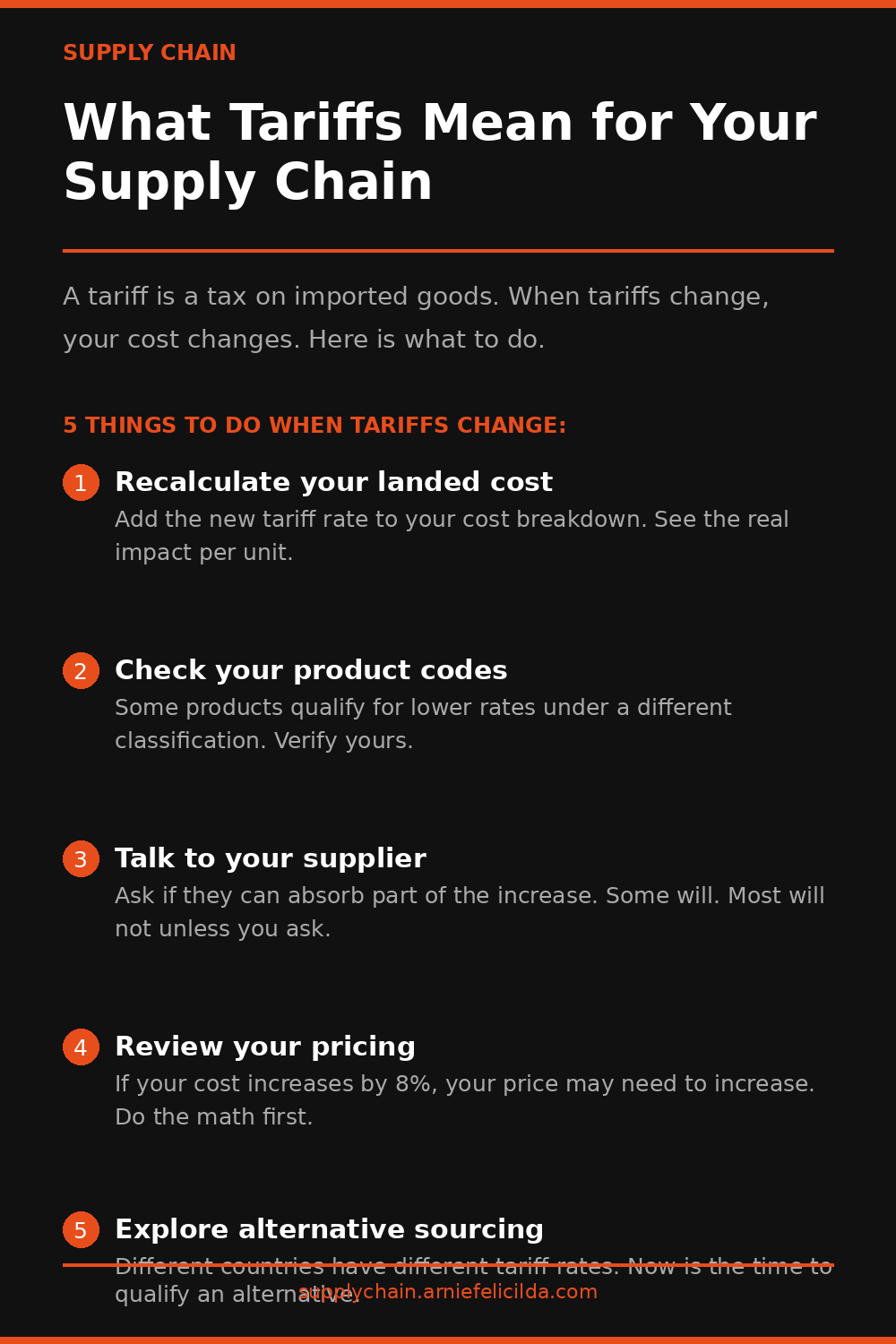
5 Things to Do When Tariffs Change
Recalculate Your Landed Cost Immediately
Add the new tariff rate to your existing landed cost calculation for every affected product. Do this before you do anything else. The number tells you whether the impact is manageable or whether it requires immediate action on pricing or sourcing.
Verify Your HS Codes
Tariff rates are applied by HS code - the customs classification number for your product. Different HS codes for similar products can have dramatically different tariff rates. Have a customs broker verify that your products are classified correctly. A reclassification can reduce your tariff exposure significantly.
Have a Direct Conversation With Your Supplier
Ask your supplier directly whether they can absorb any portion of the tariff increase. Some will say no immediately. Others will negotiate, especially if you have a strong relationship or represent significant volume. The conversation costs nothing and occasionally produces a result.
Review Your Pricing
If your landed cost increases by 8 percent, your margin decreases by 8 percent unless you adjust your price. Do the math explicitly. Decide deliberately whether to absorb the cost, pass it to customers, or split the difference. Do not let the decision happen by inaction.
Evaluate Alternative Sourcing Countries
Different countries have different tariff rates under different trade agreements. A product made in one country may face a 25 percent tariff while the same product made in another country faces 0 percent under a preferential trade agreement. Now is the time to research whether a sourcing shift makes economic sense - before you need one urgently.
Building Tariff Resilience Long Term
Businesses with diversified sourcing - multiple supplier countries for critical products - absorb tariff changes better than those concentrated in a single origin. This does not mean sourcing from everywhere. It means having a qualified alternative in at least one additional country for your highest-spend product categories.
For more on this topic, read Total Landed Cost - What Freight Actually Costs Beyond Unit Price. You may also find How to Build a Backup Supplier Plan useful for the next step.
Coming Soon - SCM Book 01
The Resilient Supply Chain
Supplier relationships, risk planning, and operational continuity for managers who cannot afford a disruption. Join the waitlist to be first when it drops.
Join the Waitlist