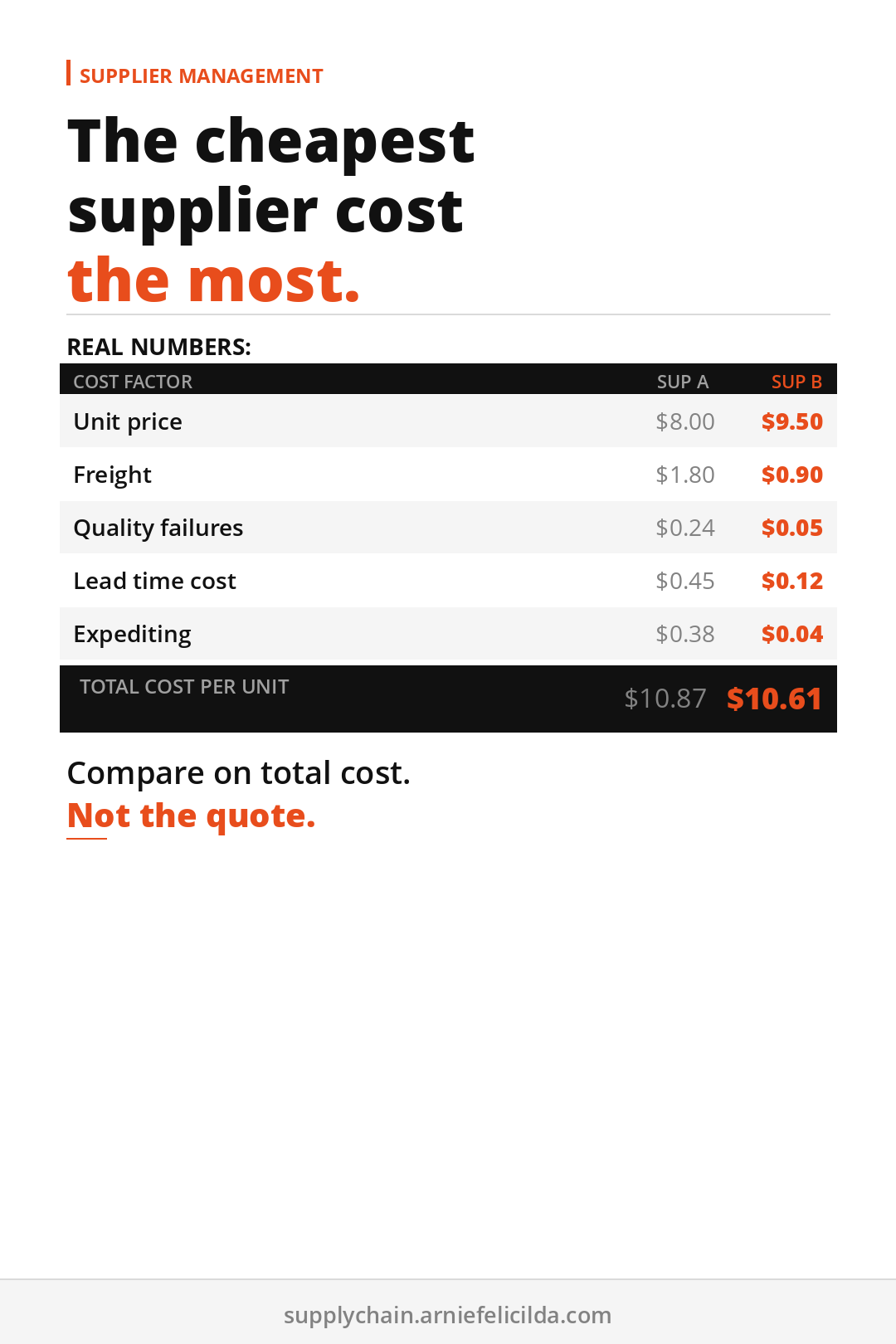
Unit price is one number. It is the easiest number to get from a supplier. It is also the most misleading number to use as the basis for a supplier decision. The cheapest supplier on unit price is routinely the most expensive supplier on total cost. Most operations managers do not find that out until they are already locked into the relationship.
Low unit cost hides four cost categories that only become visible after you have paid them. This post makes them visible before you decide.
The Four Hidden Costs Behind Low Unit Price
1. Quality Failure Cost
Defect rates, returns, and rework are not line items on a supplier quote. They show up later in customer returns, in production downtime, in the labor cost of inspecting and sorting incoming product. A supplier with a 3 percent defect rate on a $10 unit effectively adds $0.30 per unit in quality failure cost. On 10,000 units, that is $3,000 in cost that was never in the purchase price.
Suppliers who compete primarily on price often do so by reducing quality controls. The savings they pass on in unit price are often recovered in defect rates that their customers absorb.
2. Lead Time and Capital Cost
A supplier with a lower unit price but a 45-day lead time versus a 15-day lead time requires you to hold significantly more safety stock. That additional inventory has a carrying cost, typically 20 to 30 percent of inventory value annually. On a $50,000 additional safety stock position required by the longer lead time, the carrying cost alone is $10,000 to $15,000 per year. That cost does not appear on the purchase order.
Calculate the full total landed cost including the capital cost of lead time before comparing suppliers on price.
3. Reliability and Expediting Cost
A supplier who delivers on time 85 percent of the time causes stockouts, expedited freight orders, and emergency procurement events on the other 15 percent. Expedited freight can cost 3 to 5 times standard freight rates. A single air freight shipment to cover a missed sea freight delivery can eliminate months of unit price savings.
Track on-time delivery rate by supplier. A supplier at 98 percent on-time delivery is worth a price premium over a supplier at 85 percent. In most cases, the reliability premium pays for itself in avoided expediting cost within six months.
4. Relationship and Switching Cost
Low-price suppliers often provide lower service levels: slower response to issues, less flexibility on order changes, less support on compliance documentation. The management time cost of a high-maintenance supplier is real, even when it does not appear on an invoice.
Additionally, if a low-price supplier fails and you need to switch, the cost of qualifying a new supplier can run $5,000 to $20,000 depending on the product complexity. That cost is not visible when you choose the cheaper option.
A Direct Comparison: Unit Price vs. Total Cost
| Cost Factor | Supplier A (Cheap) | Supplier B (Higher Price) |
|---|---|---|
| Unit Purchase Price | $8.00 | $9.50 |
| Freight and Duties | $1.80 | $0.90 |
| Quality Failure (3% vs 0.5%) | $0.24 | $0.05 |
| Capital Cost of Lead Time | $0.45 | $0.12 |
| Expediting Cost (amortized) | $0.38 | $0.04 |
| Total Cost Per Unit | $10.87 | $10.61 |
Supplier B, $1.50 more expensive on unit price, is $0.26 cheaper per unit on total cost. At 50,000 units per year, that is $13,000 in annual savings from choosing the more expensive supplier.
This is not a hypothetical. It is the standard result when operations managers run a total cost comparison for the first time. The cheaper supplier is almost never cheaper once all costs are included.
How to Evaluate Suppliers on Total Cost
Use the free Supplier Scorecard to rate your top suppliers on unit price, quality, lead time, reliability, and service level in one structured assessment. The scorecard converts qualitative factors into a comparable score alongside price, so the comparison is complete rather than price-only.
For each supplier evaluation, collect five data points:
- Unit price and payment terms
- Quoted and actual lead time over the past 12 months
- Defect or return rate over the past 12 months
- On-time delivery rate over the past 12 months
- Landed cost including freight and duties
With those five data points, you can calculate a true total cost comparison in under 30 minutes. The decision becomes clear. Unit price is the starting point of a supplier evaluation, not the conclusion. The managers who consistently make better sourcing decisions are the ones who calculate total cost before they decide, not after they discover the problem.
Also on Pinterest: 📌 Why the Cheapest Supplier Is the Most Expensive Decision
From the Author
The Accidental Project Manager
How to deliver projects on time without a PMP and cut waste by 11.4% using AI workflows. 15-Minute Daily Sprint System, Scope Lock Framework, and 24 AI Prompts included.
Get the Book →More Supply Chain Reads
- You Don't Know Your True Inventory Cost (And It's Draining Your Cash)
- Why the Cheapest Supplier Is the Most Expensive Decision
Free Supply Chain Tools
Get free supply chain tools. calculators, scorecards, and frameworks.
Built for supply chain managers running inventory, suppliers, and logistics without a manual.