Total landed cost is the complete cost of getting a product from your supplier to your warehouse, ready for sale. It is not the unit price. It is not the unit price plus shipping. It is every cost incurred between the moment your supplier ships the product and the moment it sits in your inventory, accounted and ready.
Most operations managers compare suppliers on unit price. The ones who make consistently better sourcing decisions compare on total landed cost. Those two numbers are rarely the same. The gap between them can make a cheaper supplier more expensive than a pricier one.
What Total Landed Cost Includes
Total landed cost has seven components. Most managers track two or three. The rest are scattered across different departments and never get pulled together into a single per-unit number.
1. Unit Purchase Price
The FOB or EXW price from your supplier. This is the starting point, not the final number.
2. International Freight
Ocean, air, or road freight cost from origin to destination port or warehouse. This varies significantly by mode, volume, and market conditions. In volatile freight markets, this component alone can shift your landed cost by 15 to 25 percent.
3. Customs Duties and Tariffs
Duties are calculated as a percentage of the declared value of goods. They vary by product category, country of origin, and trade agreements. If you are not tracking duties by SKU, you are missing a cost that can range from 0 to 25 percent of unit value depending on the product.
4. Customs Brokerage and Documentation
The fees paid to a customs broker for clearance, plus documentation costs. Typically $150 to $400 per shipment, allocated across units in the order.
5. Port Handling and Terminal Fees
Fees charged at the destination port for unloading, terminal handling, and container release. These often appear on the freight forwarder invoice rather than the supplier invoice, which is why they get missed.
6. Inland Freight and Last-Mile Delivery
The cost of moving product from the port or border to your warehouse. Fuel surcharges and driver availability can create significant variance on cross-border moves.
7. Inspection and Quality Control
Pre-shipment inspection costs and laboratory testing fees. Particularly relevant for manufactured goods sourced from overseas suppliers.
The real number: On a product with a $10 unit price sourced from overseas, total landed cost commonly runs $13 to $16 per unit once all seven components are included. That is a 30 to 60 percent markup on purchase price before a single item reaches your shelf.
How to Calculate Total Landed Cost Per Unit
The formula is straightforward once you have the data:
Total Landed Cost = (Purchase Price + All Freight Costs + Duties + Brokerage + Handling + Inspection) divided by Total Units in Shipment
The difficulty is gathering the data consistently. The freight invoice arrives weeks after the purchase order. The duty bill arrives after customs clearance. The brokerage fee is buried in the freight forwarder statement.
A landed cost worksheet that captures all seven components for every shipment solves this. Use the free Total Landed Cost Calculator to run this calculation automatically for any shipment.
Why Total Landed Cost Changes Supplier Selection
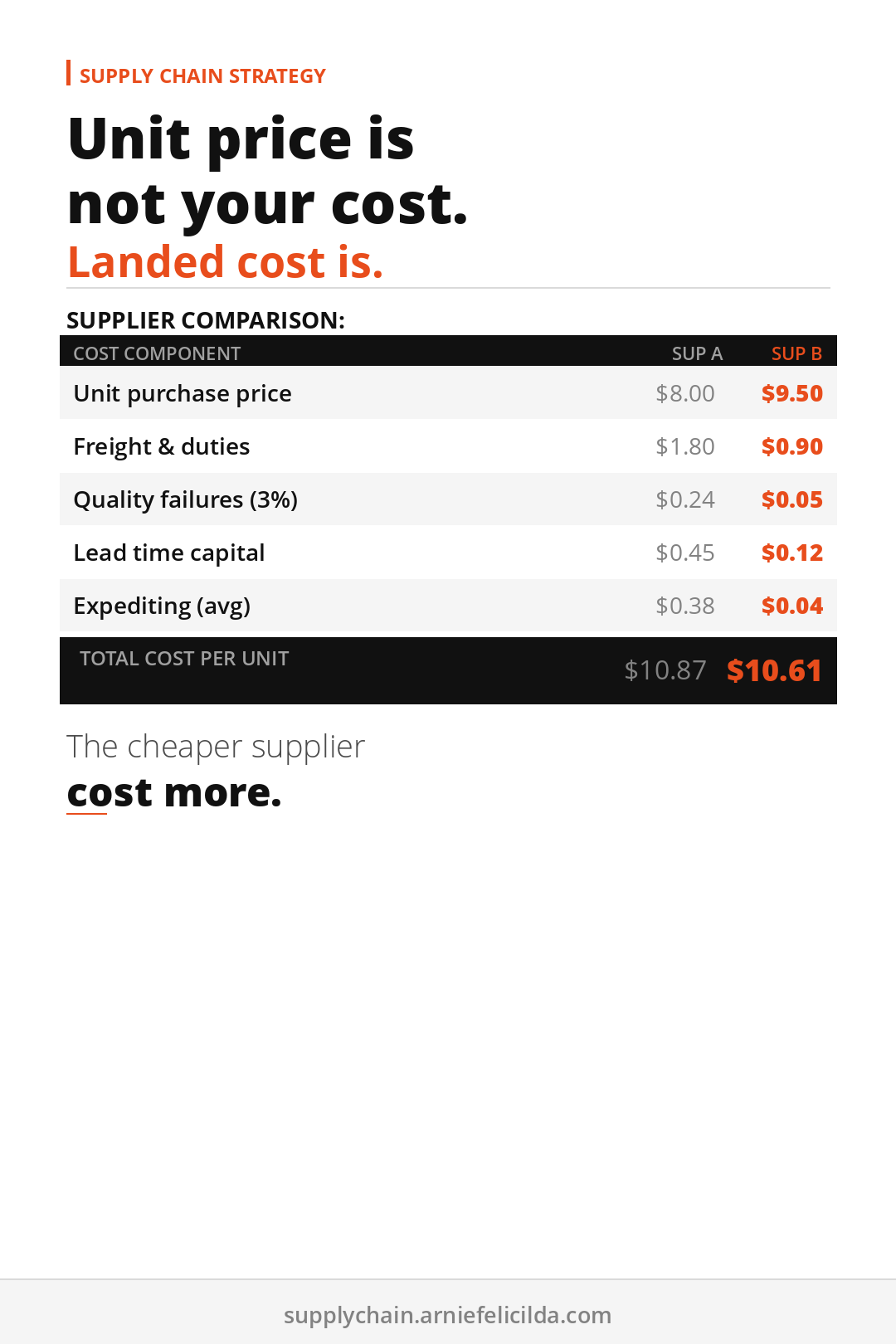
Supplier A offers a unit price of $8.00 with a 45-day lead time from overseas. Supplier B offers $9.50 with a 10-day lead time domestically. On purchase price alone, Supplier A wins by $1.50 per unit.
But Supplier A's landed cost, once freight, duties, and capital cost of the longer lead time are added, comes to $11.20 per unit. Supplier B's landed cost is $10.80. The cheaper supplier is actually $0.40 more expensive per unit on a true cost basis.
That calculation changes the supplier decision entirely. It only becomes visible when you calculate total landed cost instead of unit price. For a complete framework on evaluating supplier total cost, read Why the Cheapest Supplier Is the Most Expensive.
How Often to Calculate Landed Cost
Calculate total landed cost for every new supplier before you commit to them. Recalculate for existing suppliers annually, and any time freight rates or duty classifications change significantly. Freight rates can shift 20 to 40 percent in a quarter during volatile periods. A landed cost calculation from 18 months ago may be significantly wrong today.
Unit price is the starting point. Landed cost is the decision point. Build the habit of calculating all seven components before any sourcing decision, and you will make better supplier choices, more accurate margin calculations, and fewer surprises at the end of the quarter.
Also on Pinterest: 📌 Total Landed Cost Calculator — See What Freight Actually Costs Beyond Unit Price
From the Author
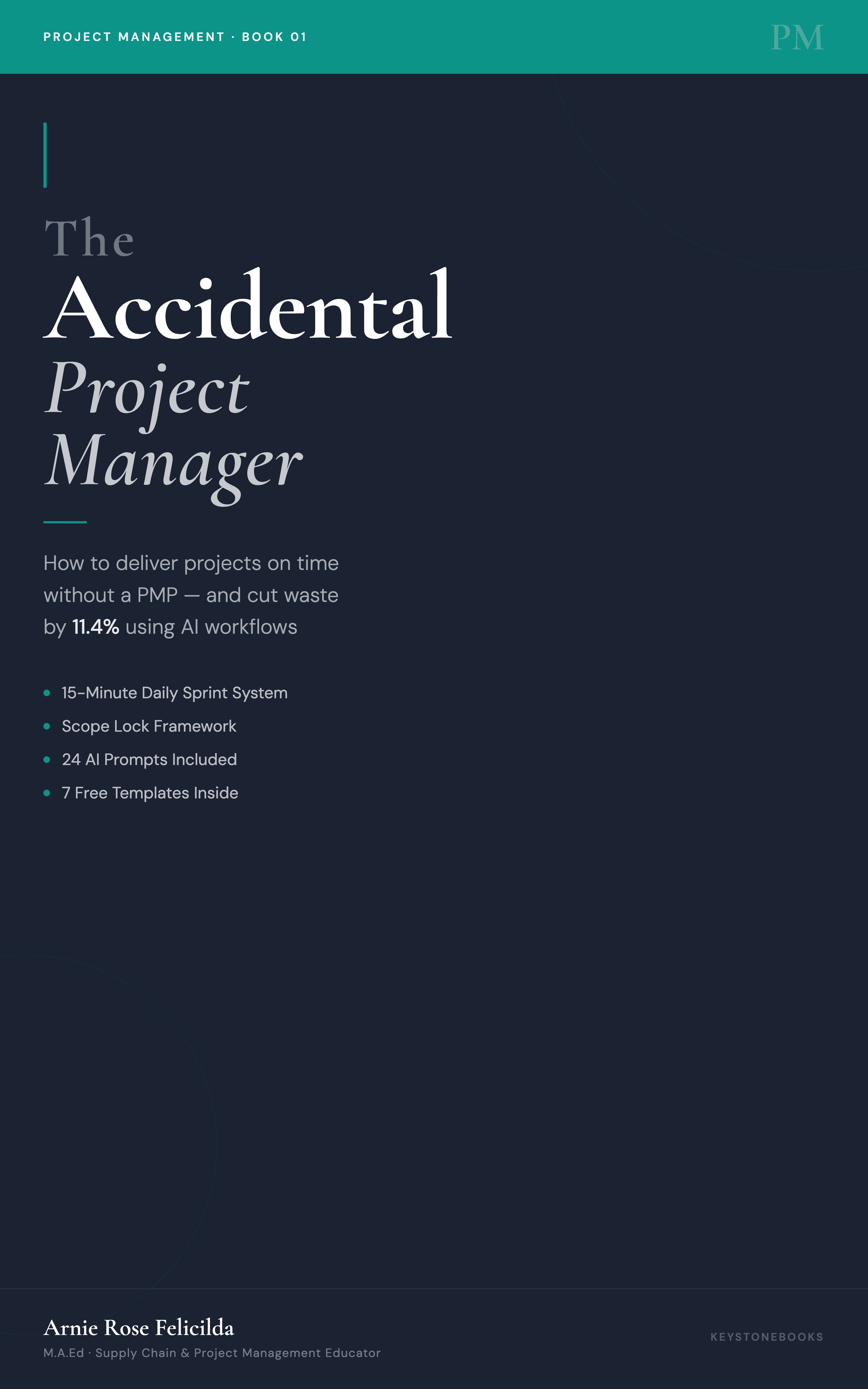
The Accidental Project Manager
How to deliver projects on time without a PMP and cut waste by 11.4% using AI workflows. 15-Minute Daily Sprint System, Scope Lock Framework, and 24 AI Prompts included.
Get the Book →More Supply Chain Reads
- You Don't Know Your True Inventory Cost (And It's Draining Your Cash)
- Why the Cheapest Supplier Is the Most Expensive Decision
Free Supply Chain Tools
Get free supply chain tools. calculators, scorecards, and frameworks.
Built for supply chain managers running inventory, suppliers, and logistics without a manual.