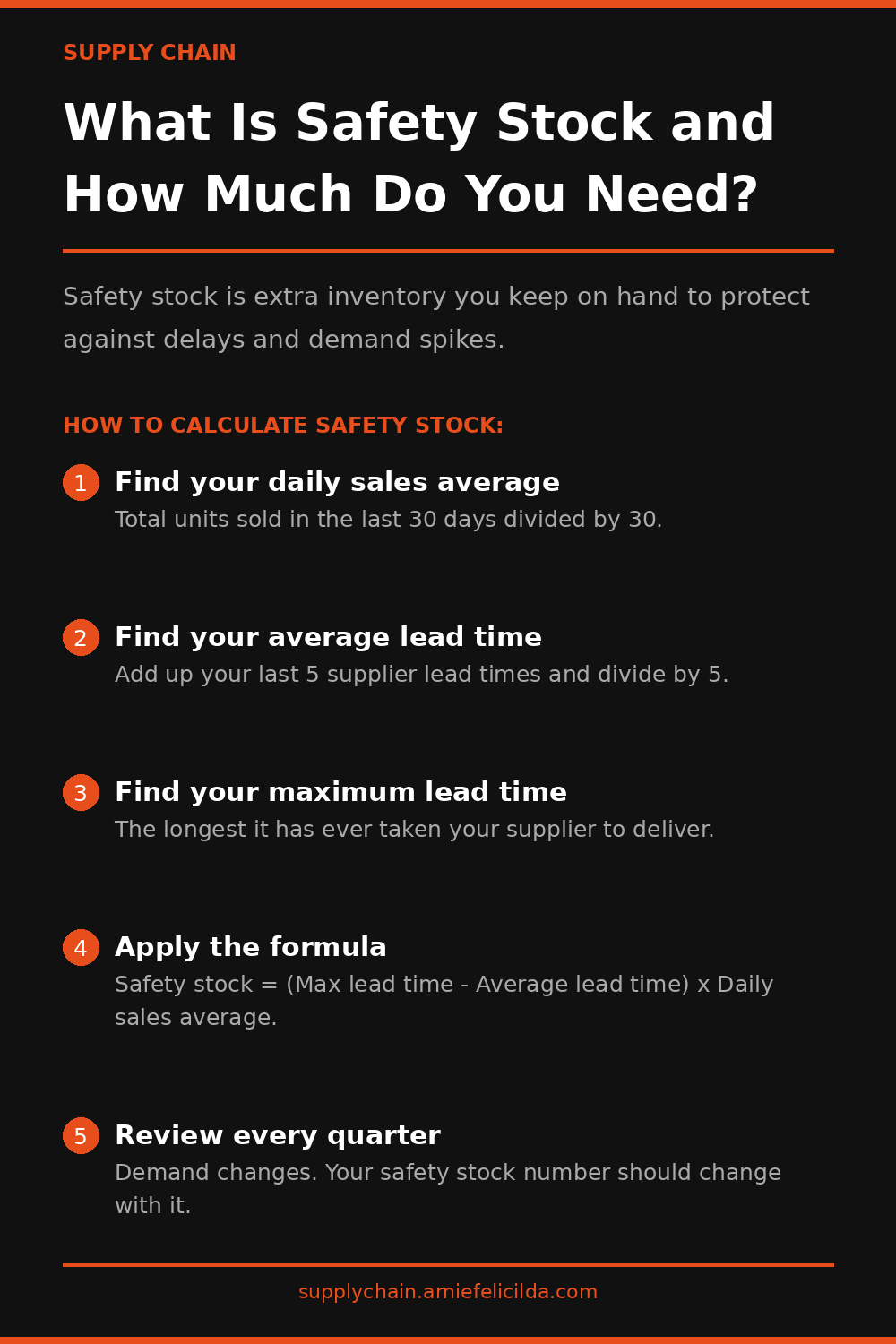
Most businesses either carry too much safety stock - which ties up cash and inflates carrying costs - or too little, which means every supplier delay turns into a customer problem. The right amount is calculated, not guessed.
Why Safety Stock Is Not the Same as Extra Inventory
Safety stock is not a buffer you add because you are not sure how much you need. It is a specific calculation based on two variables: how much your lead time varies and how much your daily demand varies. Both of those numbers are in your existing data.
Safety stock protects you from variation - in your supplier's delivery time and in your customer's buying behavior. If both were perfectly consistent, you would need zero safety stock. They are not, so you do.
How to Calculate Your Safety Stock
Find Your Daily Sales Average
Take the total units sold in the last 30 days and divide by 30. This is your baseline daily demand. If your demand is seasonal, use a 30-day window that reflects the period you are planning for.
Find Your Average Lead Time
Add up your last five supplier lead times for this product and divide by five. Lead time is measured from the day you place the order to the day the goods arrive at your location - not the day they ship.
Find Your Maximum Lead Time
Look at the same five lead times and identify the longest one. This is the worst case you have actually experienced with this supplier. It is more reliable than any promise they make about future performance.
Apply the Formula
Safety stock equals the result of maximum lead time minus average lead time, multiplied by your daily sales average. If your max lead time is 21 days, your average is 14 days, and you sell 10 units per day - your safety stock is 70 units.
Review Every Quarter
Lead times change as suppliers scale or face disruptions. Demand changes as your business grows or seasons shift. A safety stock calculation that was accurate six months ago may be wrong today. Build a quarterly review into your planning calendar.
The Cost of Getting Safety Stock Wrong
Too little safety stock and you run out during a lead time delay. The stockout costs you the lost sale, the expediting fee to restock quickly, and the customer relationship damage that comes from an out-of-stock notice.
Too much safety stock and you are paying carrying cost on units that exist only to cover a scenario that may never happen. The goal is the minimum safety stock that keeps your stockout risk at an acceptable level - not zero risk, but manageable risk.
For more on this topic, read What Is a Stockout and What Does It Actually Cost?. You may also find What Is Lead Time and Why It Affects Everything useful for the next step.
Coming Soon - SCM Book 01
Inventory Without the Anxiety
Practical inventory control for small business owners and managers tired of stockouts eating their margins and overstock draining their cash flow. Join the waitlist.
Join the Waitlist