Most businesses know their lead times in a general sense. They know it takes about two weeks or roughly a month. That approximation works until demand spikes, a supplier runs late, or a customer needs something sooner than expected. At that point, the difference between knowing and guessing becomes expensive.
How Lead Time Is Measured
Lead time starts the day you place an order - not the day the supplier confirms it, not the day they ship. It ends the day the goods arrive at your location and are available to use or sell.
This distinction matters. A supplier who ships in 5 days but uses a 10-day freight service has a 15-day lead time, not a 5-day one. Plan based on the full lead time, not the production or shipping component alone.
Track your lead times by supplier, not by product category. Two suppliers in the same category can have lead times that differ by two weeks. Treating them the same creates inventory problems.
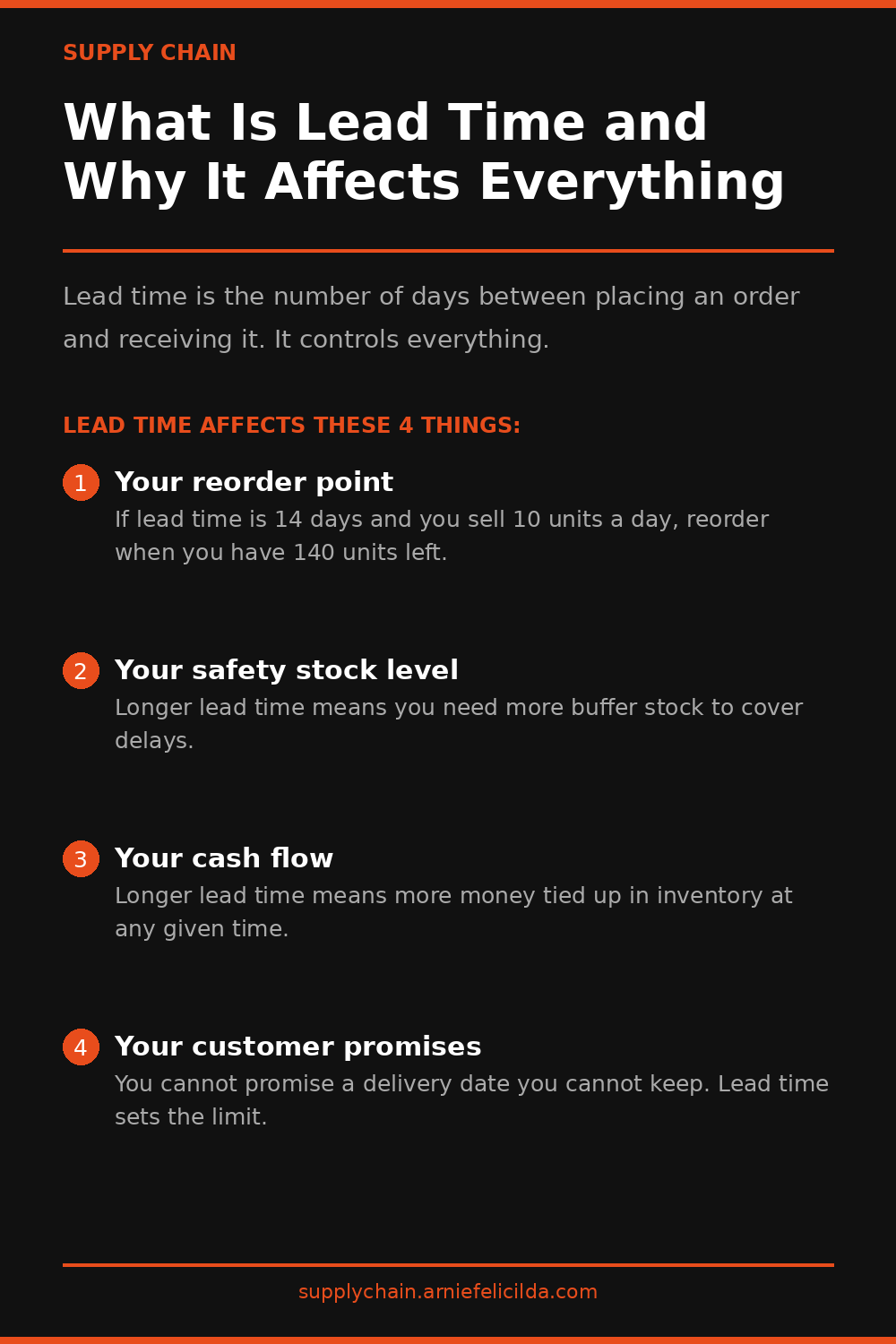
4 Things Lead Time Controls
Your Reorder Point
Your reorder point is the inventory level at which you place a new order. If your lead time is 14 days and you sell 10 units per day, you must reorder when you have 140 units left - enough to last through the full lead time. A lead time that is longer than you think means your reorder point is too low and you are regularly running closer to zero than you realize.
Your Safety Stock Level
Safety stock is calculated using the difference between your maximum and average lead time. The more your lead time varies, the more safety stock you need. A supplier whose lead time ranges from 10 to 21 days requires significantly more safety stock than one who delivers consistently in 14 days.
Your Cash Flow
During the lead time period, you have placed an order and paid for it - or committed to paying - but you do not yet have the goods to sell. The longer your lead time, the longer your cash is tied up in transit inventory. For businesses with tight cash flow, lead time reduction is a cash flow improvement.
Your Customer Delivery Promises
You cannot promise a customer a delivery date that is shorter than your lead time from supplier to customer. If a customer needs something in 5 days and your supplier lead time alone is 7 days, the answer is no - unless you have the inventory on hand. Lead time is the hard floor beneath every delivery commitment.
How to Track Lead Times Accurately
Keep a simple log for each supplier: the date each order was placed and the date each delivery was received. After five orders, you have enough data to calculate an average and a maximum. Those two numbers are all you need to set your reorder point and safety stock correctly.
For more on this topic, read What Is Safety Stock and How Much Do You Need?. You may also find How to Find a Reliable Supplier for Your Business useful for the next step.
Coming Soon - SCM Book 01
Inventory Without the Anxiety
Practical inventory control for small business owners and managers tired of stockouts eating their margins and overstock draining their cash flow. Join the waitlist.
Join the Waitlist