Most managers know stockouts are bad. Few have calculated how bad. When the full cost is laid out - not just the missed revenue, but every downstream consequence - the case for investing in proper inventory management becomes obvious.
The Difference Between a Stockout and a Shortage
A shortage means you have less than you wanted. A stockout means you have zero. Both are inventory problems, but a stockout is the more expensive one because it is visible to your customers. A shortage affects your margins internally. A stockout affects your customer relationships externally.
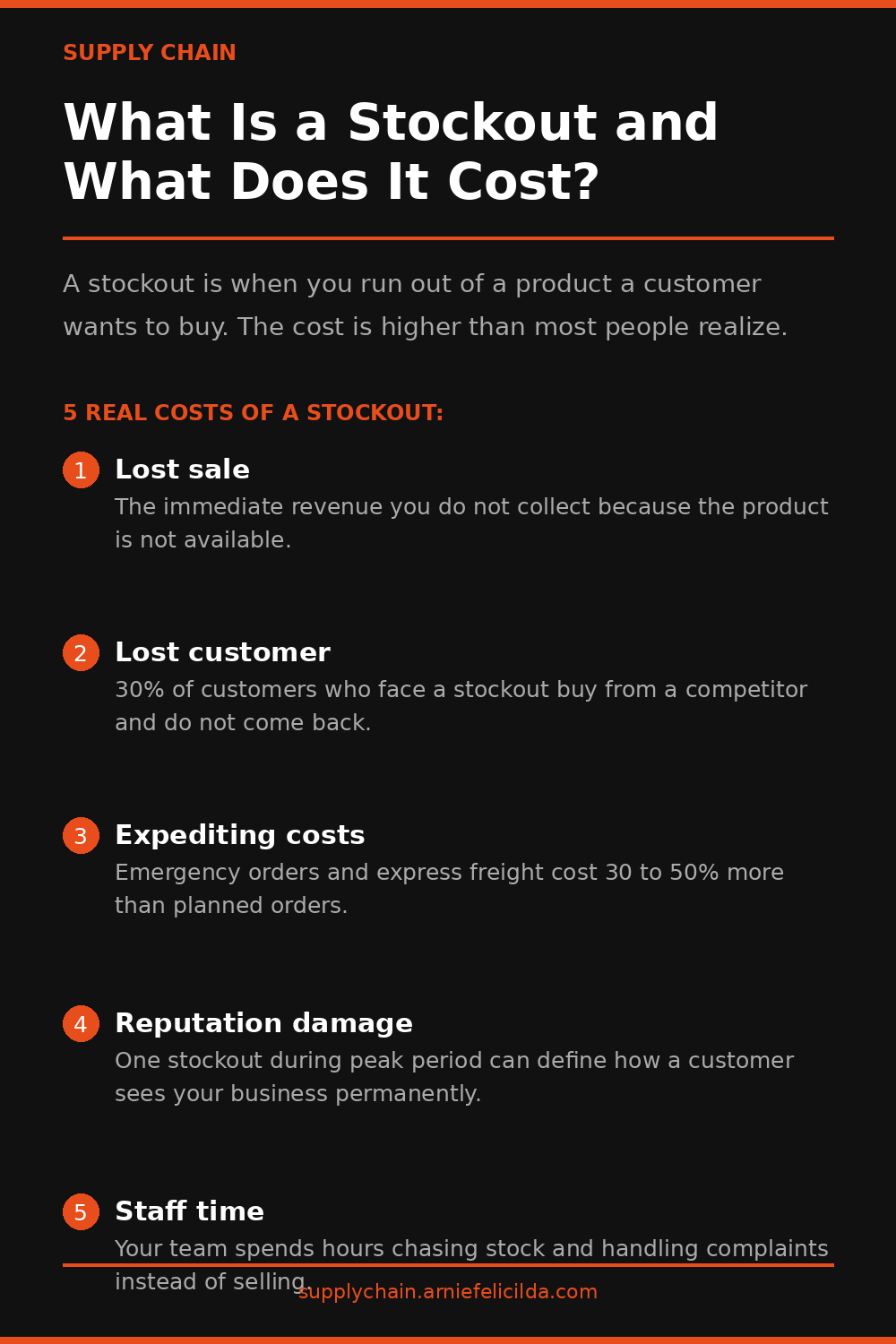
Research consistently shows that 30 percent of customers who experience a stockout buy the product from a competitor instead - and do not return. Every stockout is a permanent customer loss for roughly one in three affected buyers.
5 Real Costs of a Stockout
The Lost Sale
The most immediate cost. The revenue from the order that could not be fulfilled. For a product with a 40 percent margin, a $1,000 lost sale is $400 of margin that is gone permanently - the sale cannot be recovered once the customer goes elsewhere.
The Lost Customer
A customer who cannot get what they need from you has a reason to try your competitor. If the competitor satisfies them, you have lost not just this sale but every future sale from that customer. The lifetime value of a lost customer is often 10 to 20 times the value of the single stockout order.
Emergency Restocking Costs
Once a stockout is identified, the typical response is an emergency order with expedited freight. Expedited air freight costs 30 to 50 percent more than standard ocean or ground freight. Emergency production orders at suppliers often carry a premium. The stockout generates a cost even before the product arrives.
Staff Time and Operational Disruption
Every stockout generates hours of internal work. Customer communication, order management, supplier calls, logistics coordination. That time comes from somewhere - usually from the tasks that were supposed to move the business forward that week.
Reputation Damage
A stockout during a peak season - when demand is highest and customers are most time-sensitive - can define how a customer remembers your business. One bad experience during the holidays or a product launch is often more memorable than twelve months of reliable service.
How to Prevent Stockouts
Stockout prevention starts with accurate reorder points and maintained safety stock. If you are experiencing regular stockouts, the cause is almost always one of three things: your reorder point is too low, your safety stock is insufficient for your lead time variance, or your inventory records are inaccurate enough that you are ordering based on a number that no longer reflects reality.
For more on this topic, read What Is Safety Stock and How Much Do You Need?. You may also find How to Set Up a Simple Inventory System useful for the next step.
Coming Soon - SCM Book 01
Inventory Without the Anxiety
Practical inventory control for small business owners and managers tired of stockouts eating their margins and overstock draining their cash flow. Join the waitlist.
Join the Waitlist