Just in time became popular in manufacturing during the 1970s and 1980s. Large companies with predictable demand and highly reliable suppliers used it to dramatically reduce the cash tied up in inventory. Then the COVID-19 pandemic showed the world what happens when just in time meets a global supply chain disruption.
The question is not whether just in time works. It does - under the right conditions. The question is whether those conditions exist in your business.
How Just in Time Actually Works
Just in time is built on the idea that inventory is waste. Every unit sitting on a shelf represents cash that is not working, space that is not earning, and risk that is not generating return. The goal is to receive materials or products exactly when they are needed - not before.
Just in time does not mean zero inventory. It means minimum inventory, calibrated precisely to demand and lead time. The precision is what makes it work - and what makes it fail when that precision breaks down.
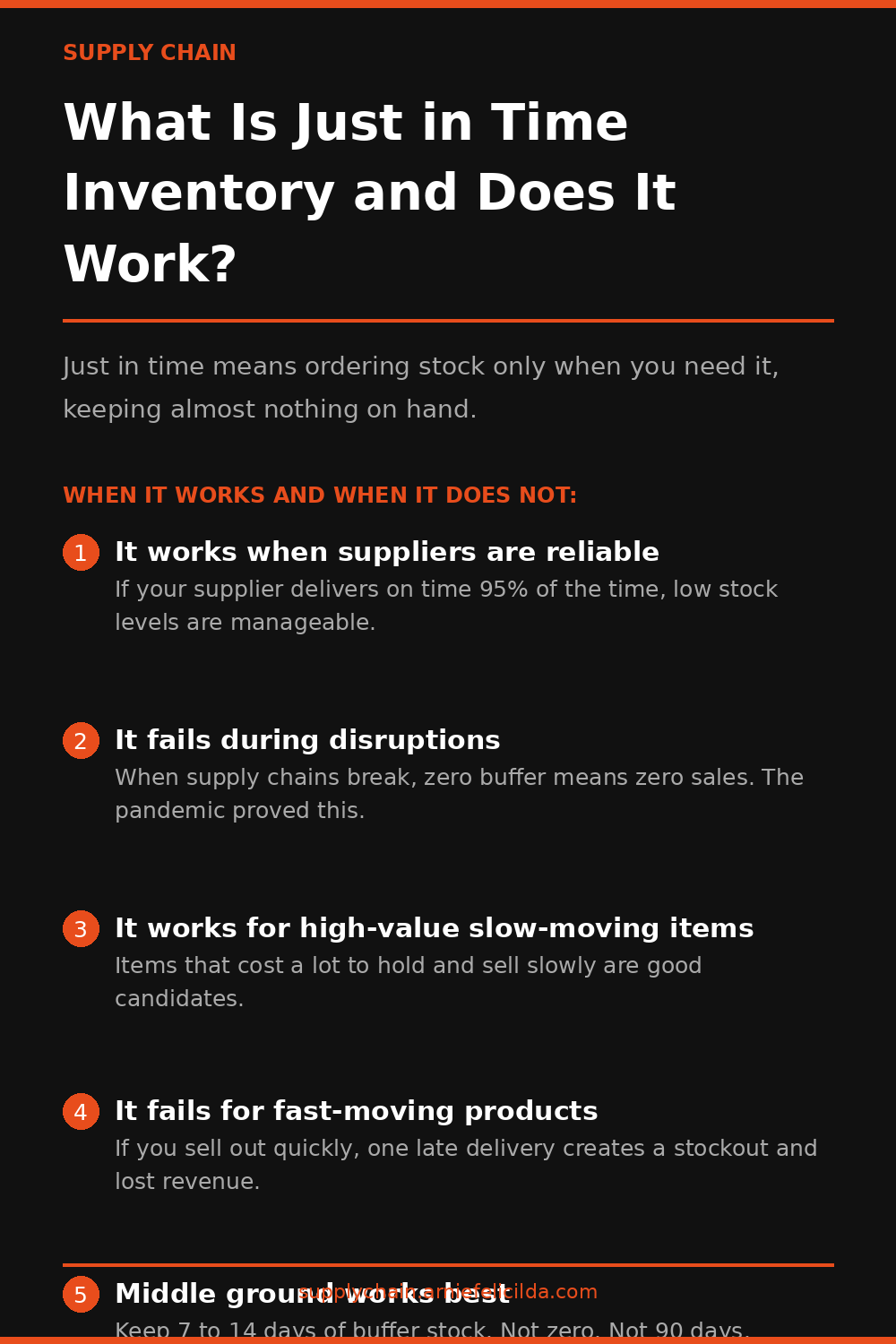
When Just in Time Works and When It Does Not
It Works When Suppliers Are Highly Reliable
Just in time requires a supplier who delivers on time 95 percent or more of the time, with a consistent lead time that varies by no more than a day or two. If your supplier delivers on time 85 percent of the time, just in time means you will face a stockout roughly every six to seven orders.
It Fails During Supply Chain Disruptions
The pandemic made this visible at a global scale. Businesses with zero buffer inventory could not respond when suppliers stopped delivering. Those with even two to three weeks of safety stock had time to find alternatives. Just in time eliminates your response time when something unexpected happens.
It Works for High-Value, Slow-Moving Items
Products that cost a lot to hold and sell slowly are good candidates. Expensive components, specialty items with low turnover, or seasonal products with predictable demand windows. The carrying cost savings on high-value items are large enough to justify the precision required.
It Fails for Fast-Moving Products
If a product sells daily and your supplier lead time is two weeks, there is no margin for error. A single supplier delay, a single demand spike, or a single receiving error creates a stockout with no buffer to absorb it.
The Middle Ground Works Best for Most Businesses
Seven to fourteen days of safety stock is not just in time, but it is close enough to capture most of the cash flow benefits while maintaining enough buffer to survive a normal supplier delay. Zero buffer is a strategy for businesses with perfect supplier relationships. Most businesses do not have those.
The Honest Assessment
Just in time is a legitimate inventory strategy. It is also frequently misapplied by businesses whose supply chains cannot support it. Before reducing your safety stock levels significantly, run the numbers on what a two-week stockout would cost you. If that cost is acceptable, you may have room to reduce your buffer. If it is not, your current safety stock level exists for a reason.
For more on this topic, read What Is Safety Stock and How Much Do You Need?. You may also find What Is a Stockout and What Does It Actually Cost? useful for the next step.
Coming Soon - SCM Book 01
Inventory Without the Anxiety
Practical inventory control for small business owners and managers tired of stockouts eating their margins and overstock draining their cash flow. Join the waitlist.
Join the Waitlist