You already have the data you need to forecast demand. Your sales history is sitting in your point of sale system, your order management platform, or your spreadsheet. The question is whether you are using it to make ordering decisions or ignoring it in favor of what feels right.
Why Forecasting Matters for Inventory
Every inventory decision you make - how much to order, when to order, how much safety stock to hold - is based on an assumption about future demand. If you are not forecasting explicitly, you are forecasting implicitly, based on whatever your instinct says. Explicit forecasting, even a simple one, beats implicit forecasting almost every time.
A forecast does not need to be perfect. It needs to be better than your current default, which is ordering based on what you ordered last time or what you think you might need.
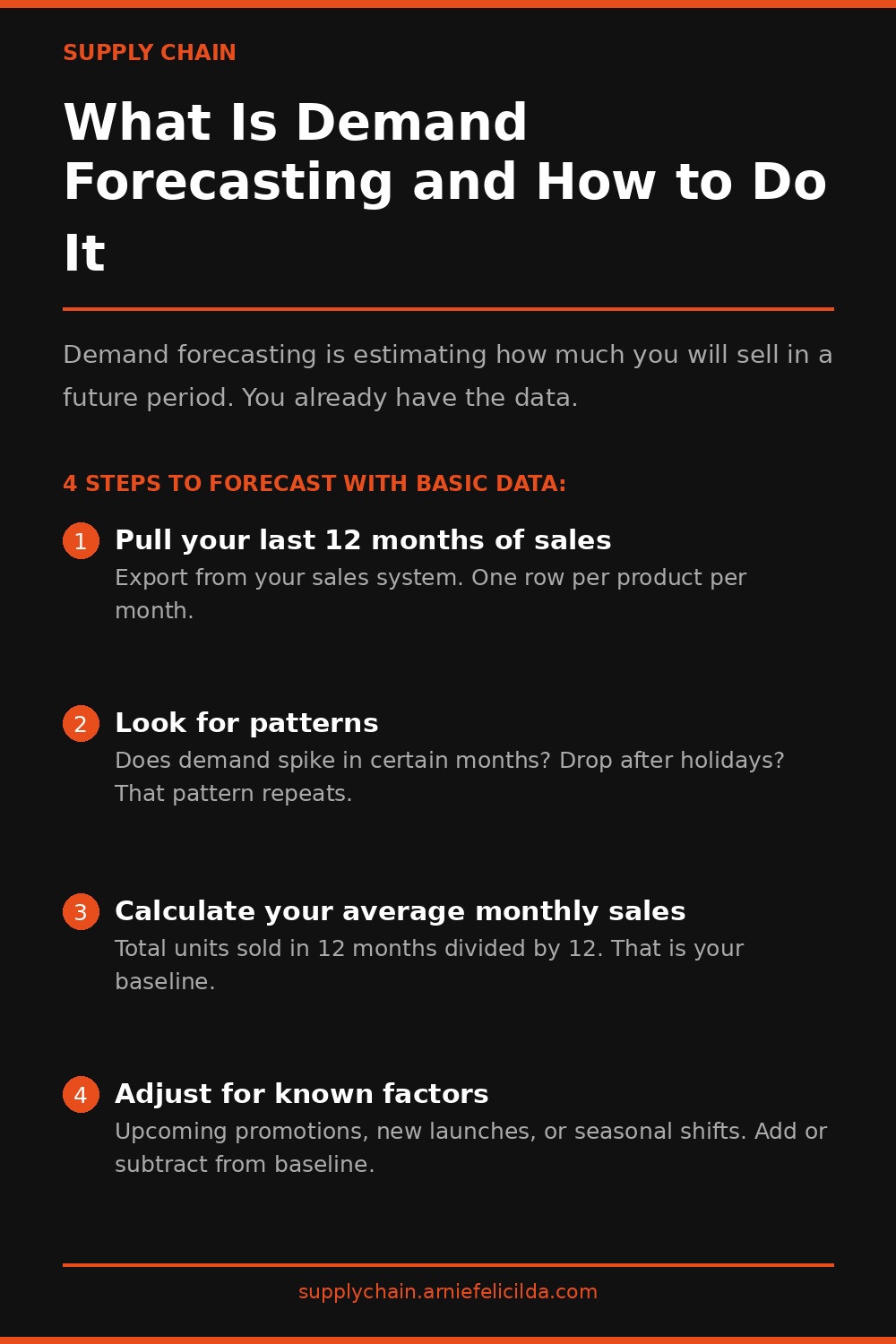
4 Steps to Forecast Demand With Data You Already Have
Pull Your Last 12 Months of Sales Data
Export your sales history by product, by month. One number per product per month. If you have less than 12 months of data, use what you have. If you are a new business with no history, use your best estimate for the first few months and replace it with actual data as it becomes available.
Identify the Patterns
Look at each product's monthly sales across the year. Is demand steady? Does it spike in certain months? Does it drop after a promotional period? Most products have at least one pattern that repeats. That pattern is your most valuable forecasting input.
Calculate Your Baseline
Total units sold over the last 12 months divided by 12 gives you your average monthly demand. This is your baseline forecast for any month without a known seasonal factor. For months with a known pattern, adjust the baseline up or down based on the historical deviation from average.
Adjust for Known Future Events
A planned promotion, a new product launch, a competitor going out of business, or a major seasonal event will affect demand in ways the historical average does not capture. Adjust your forecast explicitly for any event you know about. Document the assumption so you can measure how accurate it was after the fact.
How Accurate Does a Forecast Need to Be?
A forecast within 15 to 20 percent of actual demand is good enough to make better ordering decisions than no forecast at all. The goal is not precision - it is reduction in the planning error that drives both overstock and stockout. A rough forecast consistently applied beats a perfect forecast done once and abandoned.
For more on this topic, read What Is Safety Stock and How Much Do You Need?. You may also find How to Set Up a Simple Inventory System useful for the next step.
Coming Soon - SCM Book 01
Inventory Without the Anxiety
Practical inventory control for small business owners and managers tired of stockouts eating their margins and overstock draining their cash flow. Join the waitlist.
Join the Waitlist