Most import problems that occur at the border trace back to documentation errors that were visible before the shipment left the origin country. The commercial invoice is where most of those errors live.
Why the Commercial Invoice Matters for Customs
Customs authorities use the commercial invoice to determine what is being imported, where it came from, what it is worth, and what duties apply. An incorrect HS code can result in the wrong duty rate being applied. An undervalued invoice is considered fraud. A vague product description triggers an inspection.
Never undervalue a commercial invoice to reduce import duties. Customs authorities compare declared values against market rates and frequently audit importers. The fine for undervaluation far exceeds any duty savings.
6 Things to Check on Every Commercial Invoice
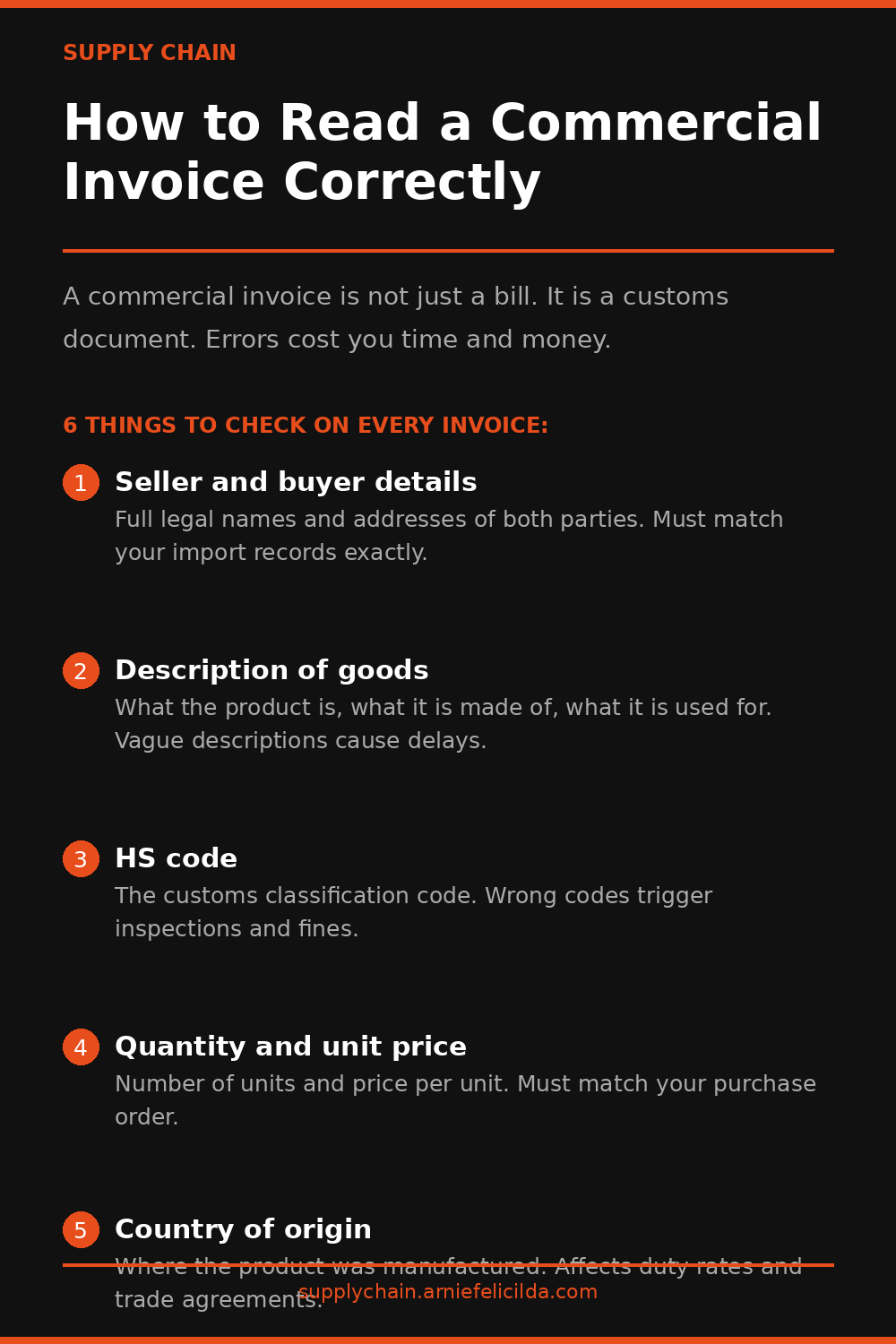
Seller and Buyer Details
Full legal name and address of the exporting company and the importing company. These must match your import records exactly - not trading names, legal names. A discrepancy between the invoice name and the importer of record name causes clearance delays.
Description of Goods
What the product is, what it is made of, and what it is used for. Customs authorities need enough detail to classify the goods correctly. A description of parts is not sufficient. Electronic components for consumer audio equipment is closer to what is needed.
HS Code
The Harmonized System code that classifies your product for customs purposes. This is a six-to-ten digit number that determines your duty rate. Verify that the HS code on every invoice matches the code you have researched and confirmed for your product. Suppliers sometimes use a default code that may not be correct for your specific product.
Quantity and Unit Price
The number of units and the agreed price per unit in the invoiced currency. This must match your purchase order exactly. Any discrepancy - even a rounding difference - needs to be resolved before shipment.
Country of Origin
Where the product was manufactured. This is not the country it shipped from - it is the country where it was produced or substantially transformed. Country of origin affects eligibility for preferential duty rates under trade agreements and may trigger additional scrutiny under trade restriction programs.
Total Invoice Value
The total declared value of the shipment. This is used to calculate import duties and VAT where applicable. Verify the arithmetic. Errors in totals cause customs holds while the discrepancy is investigated.
What to Do If You Find an Error
If you identify an error before the shipment departs, contact your supplier immediately and request a corrected invoice. Do not proceed with an incorrect invoice. Correcting a document after a shipment is in transit is significantly more difficult and may require a customs amendment that delays clearance.
For more on this topic, read Total Landed Cost - What Freight Actually Costs Beyond Unit Price. You may also find What Tariffs Mean for Your Supply Chain useful for the next step.
Coming Soon - SCM Book 01
The Resilient Supply Chain
Supplier relationships, risk planning, and operational continuity for managers who cannot afford a disruption. Join the waitlist to be first when it drops.
Join the Waitlist