When warehouse costs rise, the first instinct is to look at headcount. That instinct is almost always wrong. The cost of replacing a trained warehouse worker - recruiting, onboarding, the productivity gap during training - typically exceeds the salary savings by two to three times.
The real cost drivers in most warehouses are invisible until someone looks for them specifically.
Where Warehouse Costs Actually Hide
Warehouse cost per order is the most useful measure. If your cost per order is increasing while your order volume is stable, the problem is in the warehouse. If cost per order is stable while volume grows, your warehouse is scaling efficiently.
5 Areas to Examine First
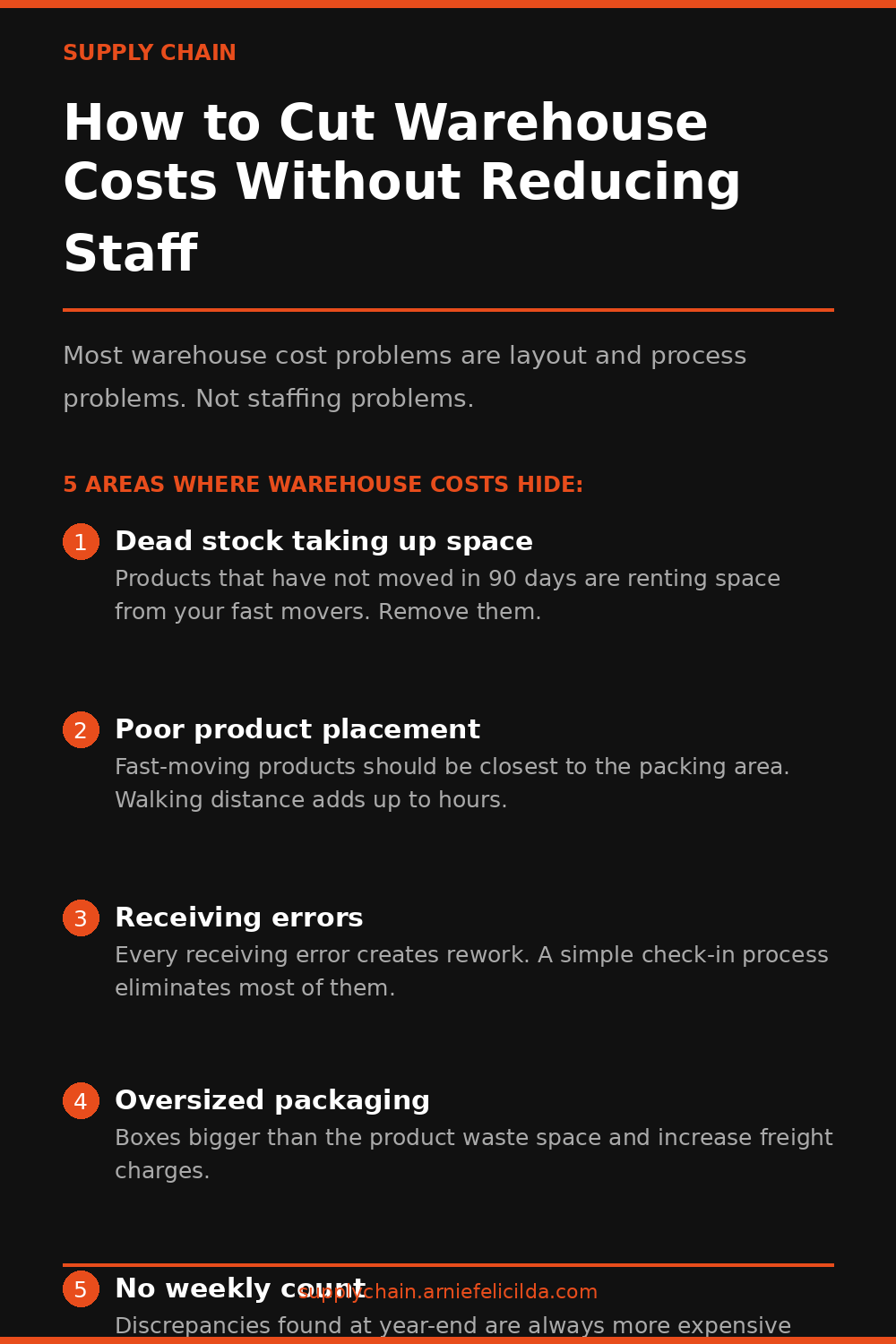
Dead Stock Consuming Active Storage Space
Products that have not moved in 90 days are occupying storage locations that your fast-moving inventory needs. When fast-movers are forced into inconvenient locations because dead stock fills the prime positions, your pick time increases on every single order. Calculate how much space your dead stock occupies and what it would cost to clear it versus what it costs to work around it daily.
Product Placement That Does Not Match Movement Speed
Your fastest-moving products should be stored closest to your packing area. Products you pick 100 times per day should never require more than 20 steps to reach. A simple slotting exercise - moving your top 20 products to the most accessible positions - can reduce total picking travel time by 20 to 30 percent with no additional staff.
Receiving Errors That Create Downstream Rework
Every item received incorrectly creates rework somewhere downstream - a mis-picked order, a wrong product shipped to a customer, a return processed, a customer service call handled. A receiving checklist that takes three minutes per shipment eliminates most receiving errors. The downstream cost of a single receiving error almost always exceeds the time cost of checking.
Packaging That Does Not Match Product Size
Oversized packaging wastes storage space inside the warehouse and increases dimensional weight charges on outbound freight. A product packed in a box twice its size pays twice the dimensional weight freight charge and occupies twice the storage space. Audit your five highest-volume shipped products and verify the box size is appropriate.
Inventory Discrepancies Found Too Late
When inventory counts are wrong, orders get mis-picked, back-orders get created unnecessarily, and emergency replenishment orders get placed. All of those outcomes are more expensive than the time spent on weekly cycle counts. Counting your top 20 products once a week takes under an hour and prevents the cascading costs that accumulate from inaccurate records.
Where to Start
Dead stock clearance produces the fastest visible result - space freed up and cash recovered within days. Product slotting produces the most sustained result - labor efficiency improvement that compounds with every order picked. Start with dead stock, then slotting, then receiving process, in that order.
For more on this topic, read How to Reduce Inventory Costs Without Cutting Stock. You may also find ABC Analysis - Find Where Your Money Actually Is useful for the next step.
Coming Soon - SCM Book 01
Inventory Without the Anxiety
Practical inventory control for small business owners and managers tired of stockouts eating their margins and overstock draining their cash flow. Join the waitlist.
Join the Waitlist