Most managers who want to reduce inventory costs start by cutting stock levels. Within 60 days, they are dealing with stockouts. The problem was never how much stock they had. The problem was how much it was costing them to hold it - and why.
Inventory carrying cost averages 20 to 30 percent of inventory value per year. On a $100,000 inventory that is up to $30,000 gone every year just to keep stock on the shelf. Most of that cost is invisible because it never appears on a single line of a profit and loss statement. It is spread across storage, capital, handling, obsolescence, and insurance.
The goal is not less stock. The goal is smarter stock. Here is how to get there without creating the stockout problems that come from cutting blindly.
Why Cutting Stock Usually Makes Things Worse
When a manager decides to reduce inventory costs by cutting stock, they usually pick the easiest number to reduce - total units on hand. They set a new target, reduce orders, and wait for the savings to show up.
What shows up instead is a stockout on a fast-moving item. Then an emergency order. Then expedited freight at 40 percent above normal cost. Then a customer complaint. The cost of that stockout often exceeds six months of the carrying cost savings they were trying to capture.
The reason this happens is that the problem was never the quantity of stock. It was the composition of stock - too much of the wrong items, not enough of the right ones, and a reorder system that was never calibrated to actual demand.
Before you reduce any stock level, identify which items you are reducing. Cutting a fast-moving item is different from removing dead stock that has not moved in 90 days. The first creates a stockout. The second creates cash.
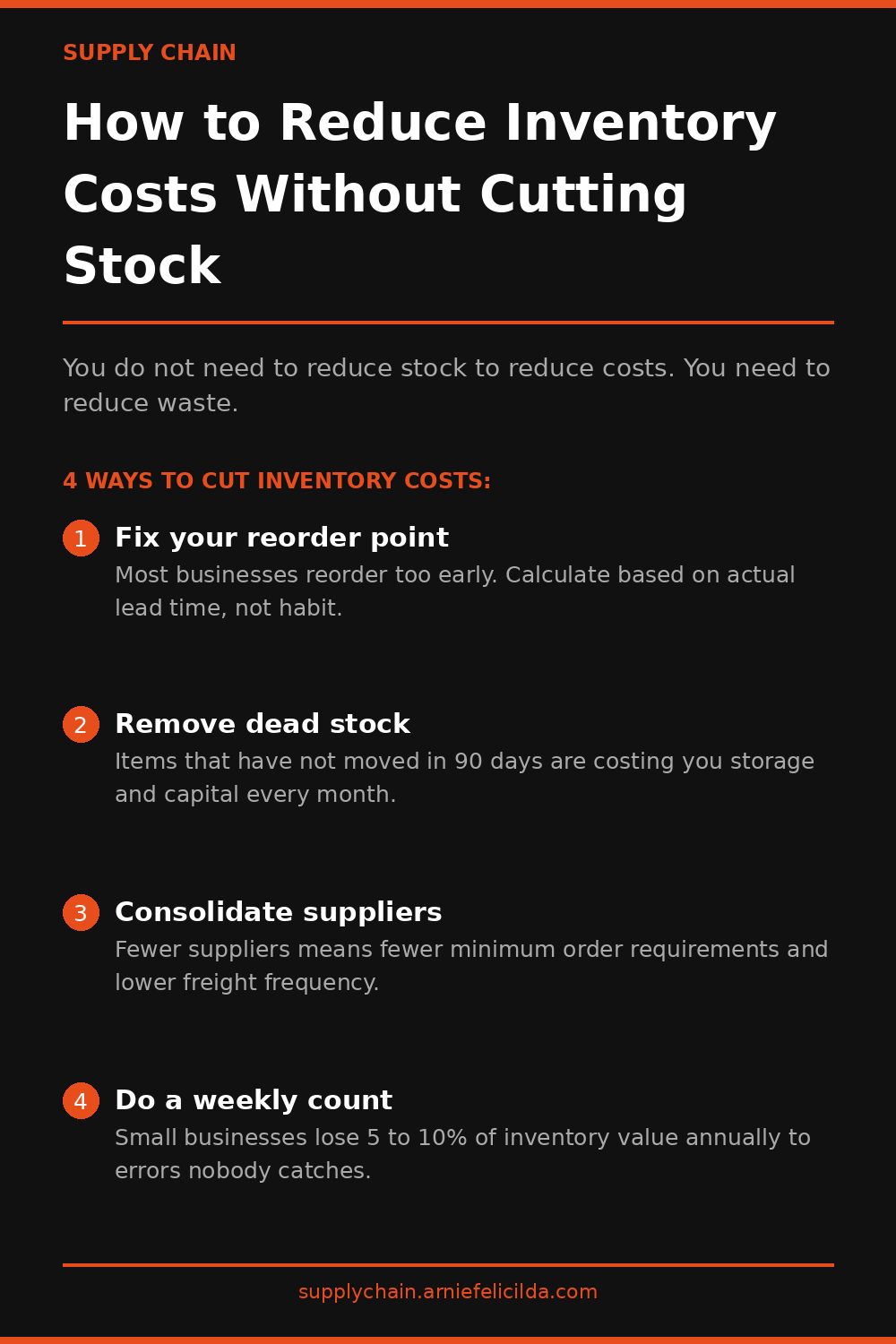
4 Ways to Reduce Inventory Costs Without Cutting Stock
Fix Your Reorder Point
Most businesses set their reorder point once and never revisit it. Lead times change. Demand patterns shift. A reorder point set for a 14-day lead time two years ago may now be based on a supplier who consistently delivers in 21 days. Every cycle you are cutting closer than you think.
Pull your last 12 months of supplier delivery data. Calculate your actual average lead time per supplier. Recalculate your reorder point based on that real number. A reorder point that triggers too early means you are holding more stock than you need - and paying carrying cost on inventory that is just sitting there waiting.
Remove Dead Stock First
Dead stock is inventory that has not moved in 90 days or more. It is not generating revenue. It is consuming storage space, tying up capital, and accumulating obsolescence risk every week it sits there.
Run a report of every product that has had zero movement in the last 90 days. For each item, decide: liquidate at a discount, return to supplier if the contract allows, bundle with a fast-moving product, or write it off. Any of those four options is better than paying to store it indefinitely.
This single step frees up space, releases capital, and reduces your carrying cost without touching a single unit of active inventory.
Consolidate Your Suppliers
Every supplier relationship comes with a minimum order quantity. If you have 15 suppliers, you are placing 15 separate orders, paying 15 separate freight charges, and holding 15 separate safety stock buffers. The total inventory driven by minimum order requirements alone can represent 15 to 25 percent of your total stock.
Review your supplier list. Identify categories where you are using two or three suppliers for similar products. Consolidate to one per category where possible. The reduction in minimum order complexity alone reduces the inventory you are required to hold just to qualify for each order.
Count Your Top 20 Products Every Week
Inventory discrepancies are one of the most underestimated sources of carrying cost. When your system says you have 200 units but you physically have 180, you are making reorder decisions based on a number that does not exist. You reorder earlier than needed. You hold more than you planned. You pay carrying cost on phantom inventory.
Pick your top 20 products by revenue. Count them physically every week. Compare to your system. Any difference above two percent gets investigated immediately. This single habit, done consistently, eliminates most of the inventory variance that silently inflates your carrying cost over time.
Where to Start This Week
Do not try to implement all four at once. Pick one and finish it before moving to the next.
If you have never calculated your true carrying cost, start there. Pull your total inventory value, multiply by 25 percent, and divide by 12. That is what your inventory is costing you every month just to exist on your shelf. That number will make every other step on this list feel urgent.
If you already know your carrying cost, start with dead stock. It is the fastest win with no system changes required - just a decision about what to do with items that are not moving.
Once dead stock is cleared, move to your reorder points. That is where the ongoing cost reduction lives - not in the one-time clear-out, but in the calibration that stops over-ordering from happening in the first place.
For a full breakdown of what your inventory is actually costing you, read Inventory Carrying Cost - What It Actually Costs You to Hold Stock. And if you want to identify which products are driving your highest costs, ABC Analysis - Find Where Your Money Actually Is walks through the full classification process in 10 minutes.
Coming Soon - SCM Book 01
Inventory Without the Anxiety
Practical inventory control for small business owners and managers tired of stockouts eating their margins and overstock draining their cash flow. Join the waitlist to be first when it drops.
Join the Waitlist