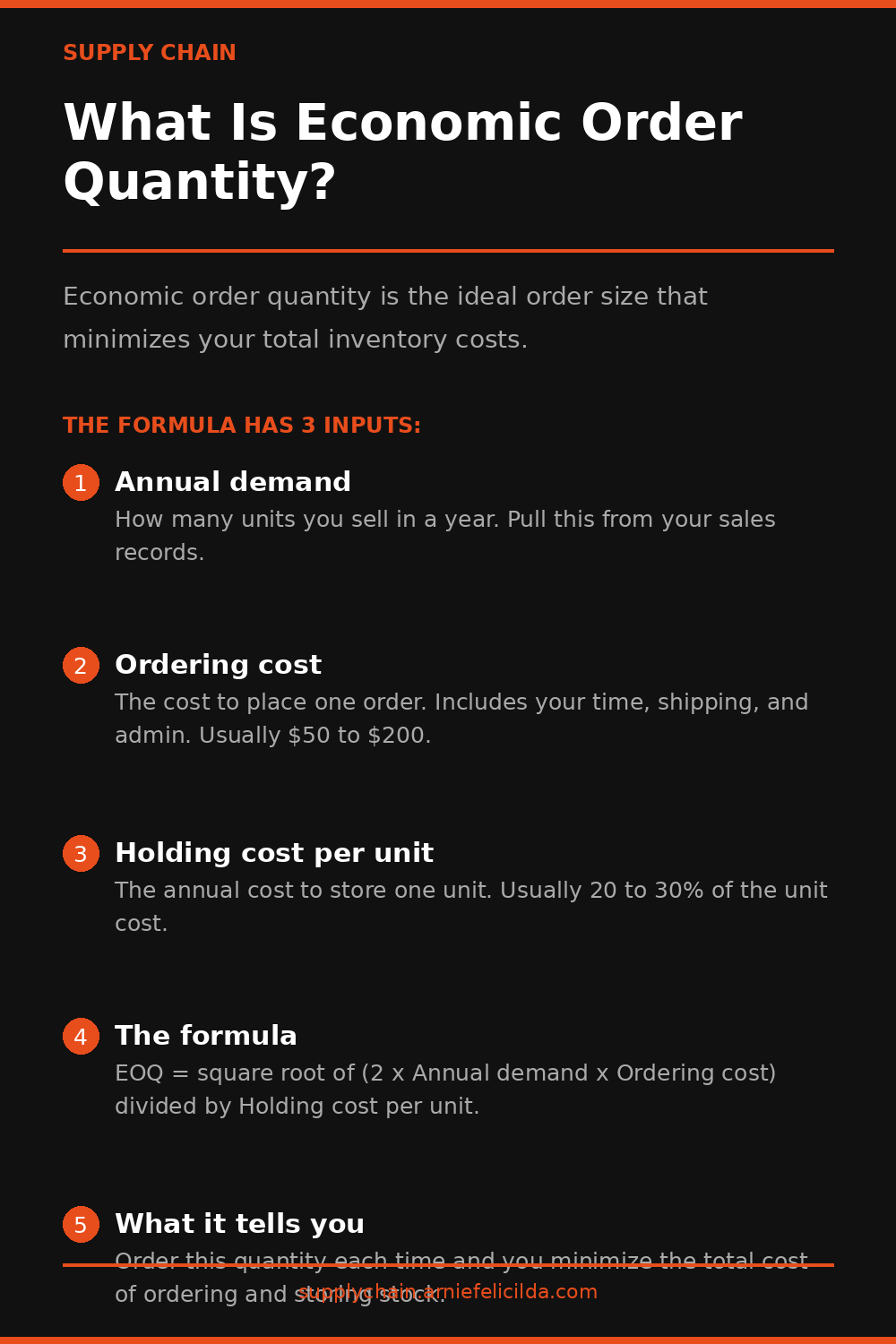
Most businesses choose their order quantities based on supplier minimums, shipping container sizes, or rough intuition about what feels right. Economic order quantity replaces that intuition with a calculation that accounts for the actual cost of ordering and the actual cost of holding.
The Two Costs That EOQ Balances
Every time you place an order, you pay a fixed cost - your time, the admin work, the freight charge, and any minimum order fees. The more frequently you order, the more often you pay that fixed cost.
Every unit you hold in inventory costs money - storage, insurance, capital, and obsolescence risk. The more you order at once, the more you hold on average, and the higher your carrying cost.
Ordering too often costs money in fixed order costs. Ordering too much at once costs money in carrying costs. Economic order quantity finds the point where those two costs are equal - and that point is the minimum total cost.
The EOQ Formula
Annual Demand
The total number of units you sell or use in a year. Pull this from your sales records. If your demand is seasonal, use your total annual figure rather than a monthly projection.
Ordering Cost
The total cost to place one order. This includes your time spent on the purchase order and follow-up, any fixed freight charges per order, bank transfer fees, and administrative overhead. Most small businesses find this is between $50 and $200 per order when staff time is included.
Holding Cost Per Unit Per Year
The annual cost to store one unit. This includes the capital cost of that unit, storage space allocation, insurance, and obsolescence risk. A standard estimate is 20 to 30 percent of the unit cost per year.
The Calculation
EOQ equals the square root of the quantity two times annual demand times ordering cost, divided by holding cost per unit per year. A product with annual demand of 1,200 units, an ordering cost of $100, and a holding cost of $5 per unit per year has an EOQ of approximately 219 units.
How to Use the Result
Order approximately this quantity each time. You may need to round up or down to meet supplier minimums or container sizes. The EOQ is a target, not a rigid rule. Anything within 10 to 15 percent of the EOQ is close enough to capture most of the cost benefit.
When EOQ Is Most Useful
Economic order quantity is most useful for products with stable demand and known costs. It is less useful for highly seasonal products or products with unpredictable demand, where the demand input changes frequently enough that the calculation would need constant updating.
For more on this topic, read How to Reduce Inventory Costs Without Cutting Stock. You may also find Inventory Carrying Cost - What It Actually Costs You to Hold Stock useful for the next step.
Coming Soon - SCM Book 01
Inventory Without the Anxiety
Practical inventory control for small business owners and managers tired of stockouts eating their margins and overstock draining their cash flow. Join the waitlist.
Join the Waitlist