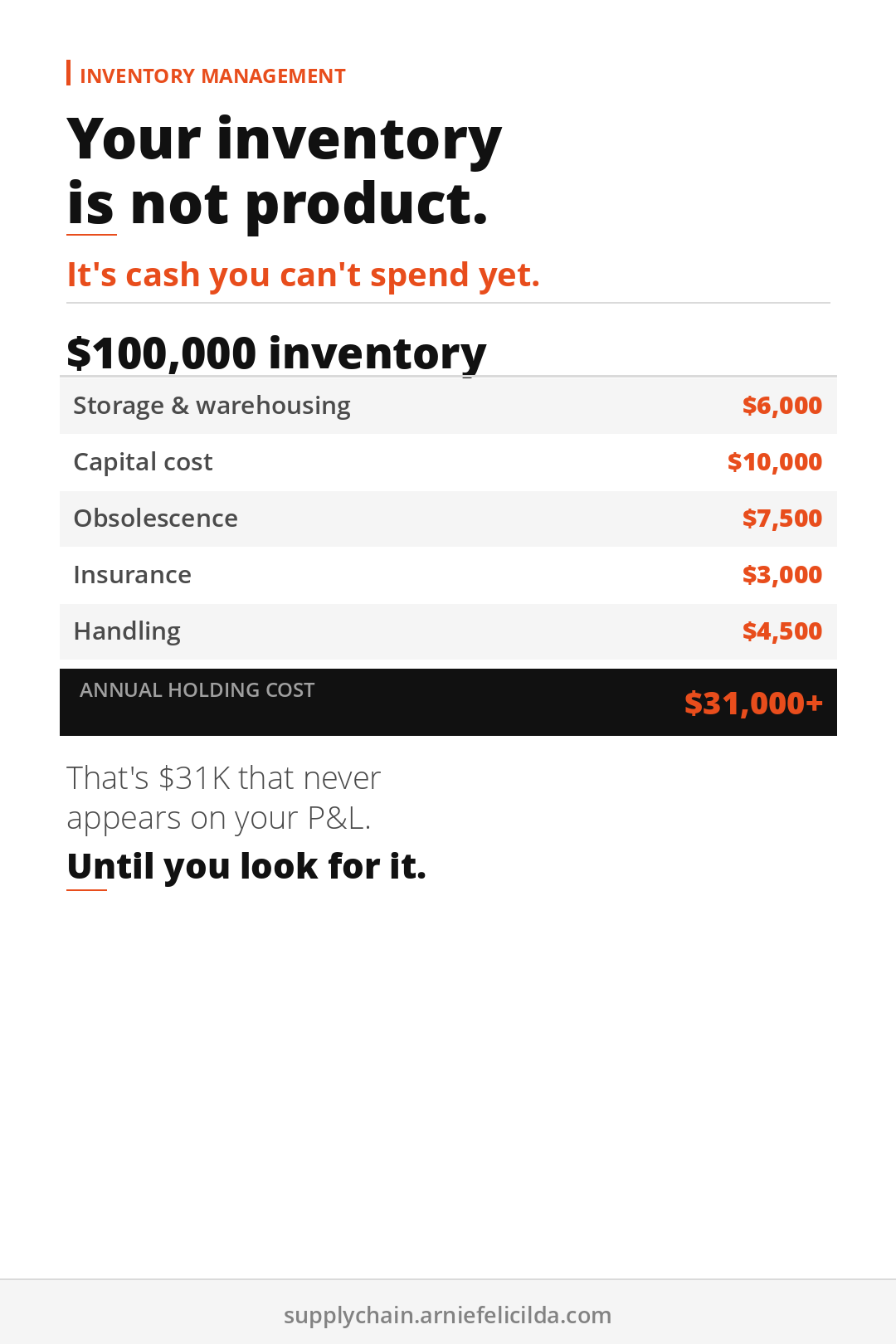
Every item sitting on your shelf right now is cash. Not future cash. Not potential revenue. Cash locked in a form you cannot spend, invest, or use to pay your suppliers or your team.
Most operations managers think about inventory as product. The ones who manage cash flow well think about inventory as money. That shift changes every decision: what you order, how much, and how long you let it sit before you act.
20-30%
Average annual carrying cost as a percentage of inventory value
$25k
Average annual carrying cost on a $100k inventory position
40%
Of inventory value in many businesses is slow-moving or obsolete
What Inventory as Cash Actually Means
When you spend $50,000 on inventory, that money does not disappear. It transforms into product on a shelf. But it is still $50,000, in a form that requires a customer, a sale, and a payment cycle before it comes back as usable cash.
The problem is not buying inventory. The problem is holding it longer than necessary, in quantities larger than demand requires, without tracking what that holding costs every day.
The number most managers never see is carrying cost: the total annual cost of holding your inventory, expressed as a percentage of your average inventory value. Industry standard is 20 to 30 percent. On a $100,000 inventory position, that is $20,000 to $30,000 per year to hold it.
That $25,000 average annual carrying cost on a $100k inventory is not a single line item in most P&Ls. It is spread across warehouse rent, insurance premiums, obsolescence write-offs, and capital cost. Most managers never see the full number in one place.
The Five Costs Hidden Inside Your Inventory
Carrying cost is not one cost. It is five costs bundled together that most operations never calculate as a single number.
Cost 01
Capital Cost
8 to 12% of inventory value annually. The return you could have earned if this money were invested or used to pay down debt.
Cost 02
Storage and Warehousing
3 to 6% annually. Rent, utilities, racking, and labor to manage the physical space.
Cost 03
Insurance
1 to 3% annually. Coverage scales with inventory value. Most managers have not recalculated this in 12 months.
Cost 04
Obsolescence and Spoilage
5 to 10% annually. Products that expire, go out of season, or become unsellable. The most controllable carrying cost. The most ignored.
Cost 05
Handling and Admin
2 to 4% annually. Labor cost of receiving, storing, counting, and managing inventory. Scales with volume and complexity.
How to Calculate Your Carrying Cost Today
You need four numbers:
- Your average inventory value over the past 12 months
- Your annual warehousing and storage costs
- Your annual insurance cost allocated to inventory
- Your estimated obsolescence and write-off percentage
Add those costs together. Divide by your average inventory value. Multiply by 100. That is your carrying cost percentage. If the number is above 25 percent, you have a holding problem. Use the free Inventory Health Calculator to run this calculation automatically.
What to Do When Your Inventory Costs Too Much to Hold
Once you know your carrying cost, the path forward is clear. Start with the highest-cost inventory first.
Run an ABC analysis on your SKUs to identify which items generate 70 to 80 percent of your revenue. These are your A items. They get the tightest inventory controls, the most frequent reordering, and the lowest days-on-hand target.
Your C items, the bottom 50 percent by revenue contribution, are often responsible for a disproportionate share of your carrying cost. Slow movers accumulate in warehouses because no one actively manages them down. A quarterly review of C items with a clear liquidation or discontinuation policy recovers more cash than most operational improvements.
The Mindset Shift That Changes Everything
Every time you approve a purchase order, ask one question before you sign it: how long will this cash be locked up before it comes back?
If the answer is more than 60 days for a standard item, or more than 30 days for a fast-moving item, the order quantity needs review. Not because buying is wrong. Because holding too much for too long is a cash flow decision disguised as an inventory decision.
Your inventory is cash. Manage it like cash. Review its performance like cash. When it stops moving, treat the recovery of that cash as urgently as you would treat a late receivable. Start by calculating your carrying cost this week. That single number will reframe every inventory decision you make going forward.
Also on Pinterest: 📌 Your Inventory Is Cash in Disguise
From the Author
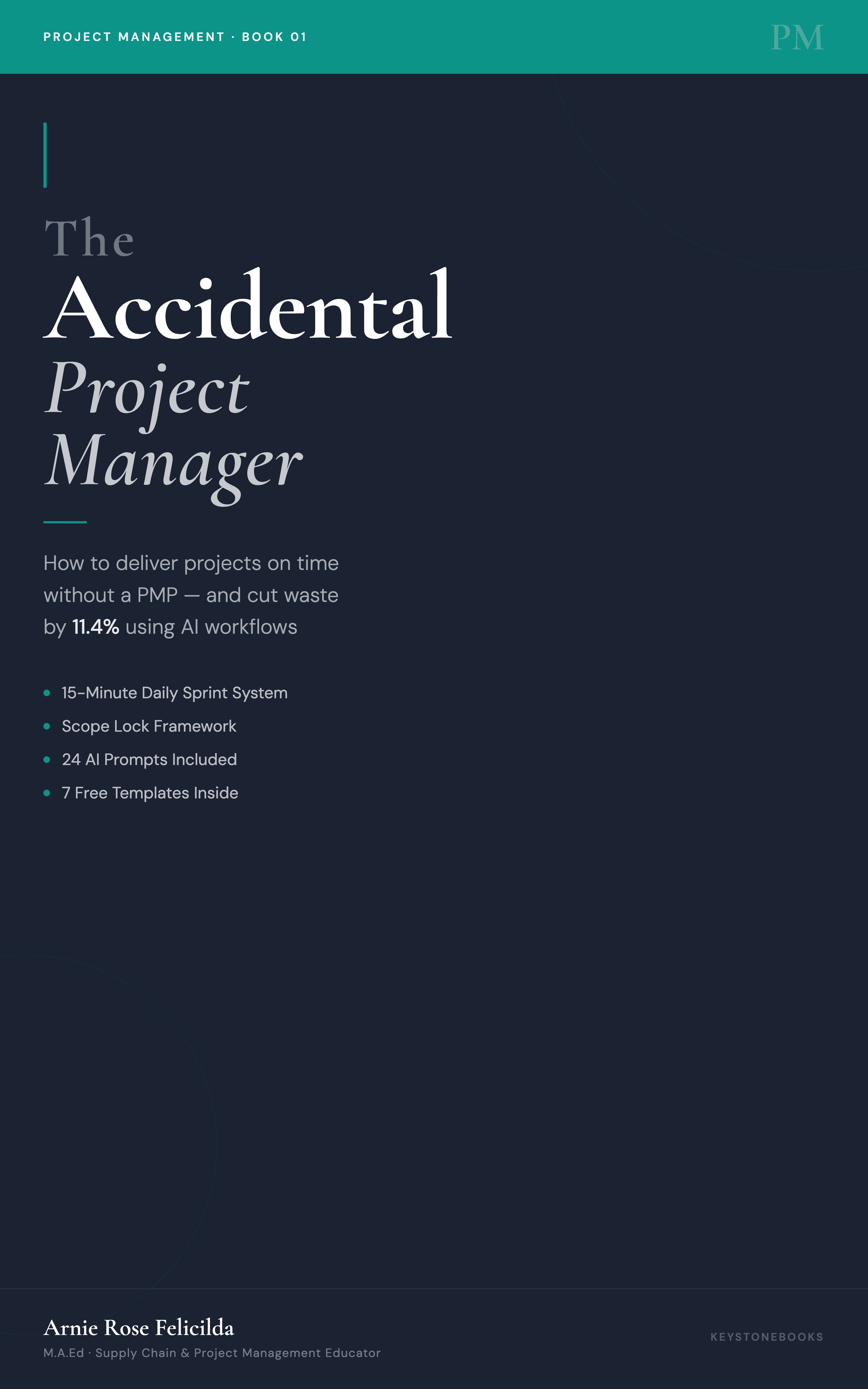
The Accidental Project Manager
How to deliver projects on time without a PMP and cut waste by 11.4% using AI workflows. 15-Minute Daily Sprint System, Scope Lock Framework, and 24 AI Prompts included.
Get the Book →More Supply Chain Reads
- You Don't Know Your True Inventory Cost (And It's Draining Your Cash)
- Why the Cheapest Supplier Is the Most Expensive Decision
Free Supply Chain Tools
Get free supply chain tools. calculators, scorecards, and frameworks.
Built for supply chain managers running inventory, suppliers, and logistics without a manual.