A supply chain risk assessment is not a crisis management exercise. It is a regular operational practice: the deliberate identification of vulnerabilities before they become disruptions. Most businesses do not run one until something breaks. By then the cost is already paid.
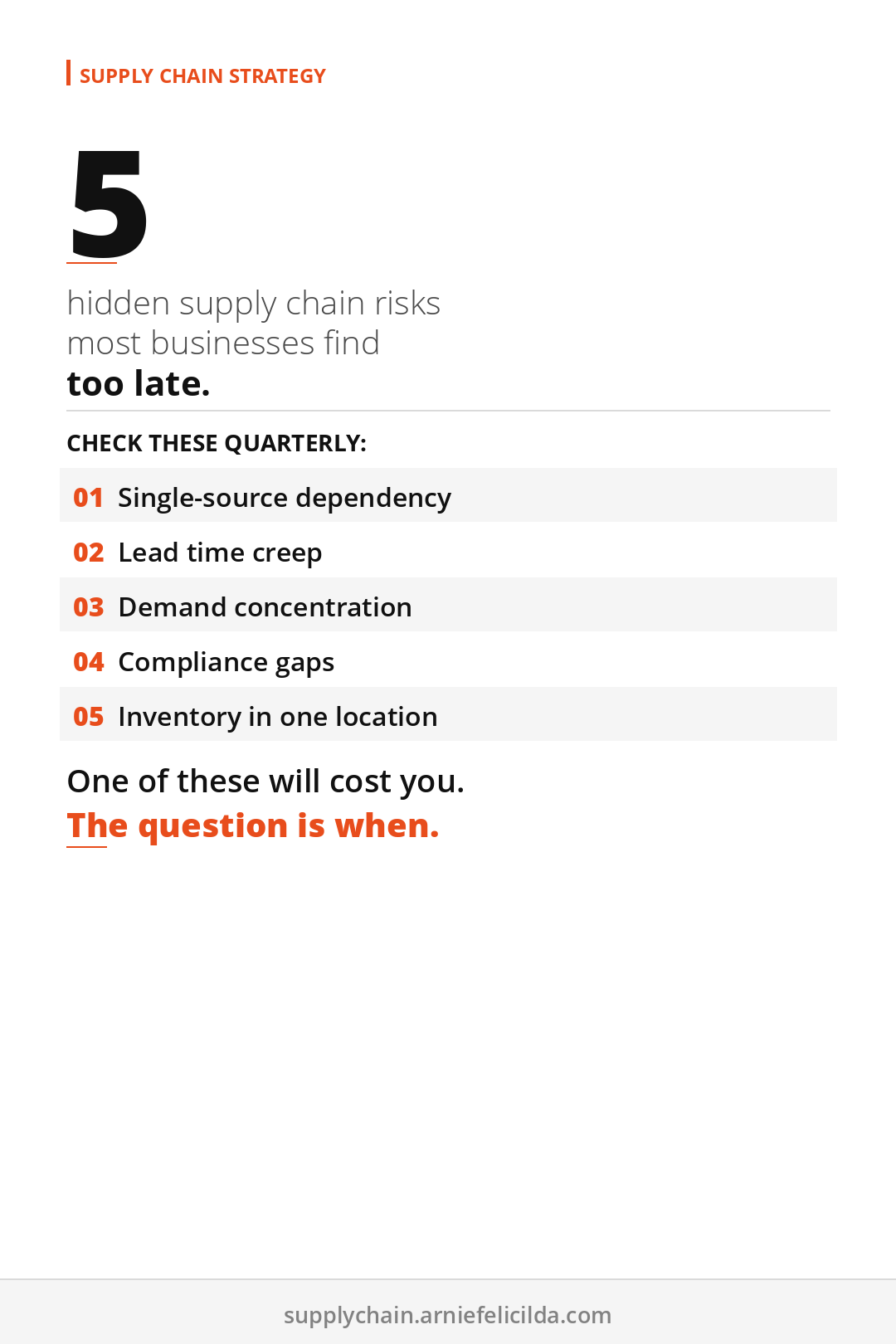
The five risks below consistently appear in supply chains that look stable from the outside but are one event away from a serious operational problem. All five are manageable when identified early. None of them are visible without a deliberate assessment process.
Why Supply Chain Risk Goes Unassessed
The honest reason is bandwidth. Operations managers are managing daily execution: orders, shipments, inventory counts, supplier communication. Risk assessment feels like a planning exercise that belongs in a strategy meeting, not in the daily workflow.
The result is that most small and mid-size operations run their supply chains reactively. They respond to disruptions rather than anticipating them. And because disruptions in a supply chain compound, one late shipment causes a stockout, which causes a lost sale, which causes a cash flow gap, the cost of reactive management is always higher than the cost of proactive assessment.
The minimum viable risk assessment: Review these five risks once per quarter. Set a 60-minute calendar block. Answer the signal questions for each risk. Act on anything that scores as high. That is the entire process.
The 5 Hidden Supply Chain Risks
Risk 01
Single-Source Dependency
If one supplier provides more than 60 percent of a critical input or product category, you have a single-source dependency. It does not matter how reliable that supplier has been historically. A factory fire, a port shutdown, a financial difficulty on the supplier's end, or a geopolitical event can eliminate your supply without warning.
The fix is not necessarily dual-sourcing everything. That is operationally expensive. The fix is identifying your critical single-source dependencies and having at least a qualified backup supplier on file, even if you never use them under normal conditions.
Warning signal: You have a supplier you have never considered replacing because they have always been fine.
Risk 02
Lead Time Creep
Lead time creep is the gradual increase in supplier delivery times that happens so slowly most managers do not notice until their reorder points are completely miscalibrated. A supplier who delivered in 21 days two years ago now consistently delivers in 35 days. But your reorder point was set for 21-day lead time. Every cycle, you are cutting it closer than you think.
Track actual lead time by supplier every quarter. Compare it to the lead time assumption in your reorder point calculation. Adjust before the gap causes a stockout.
Warning signal: You have not reviewed your reorder points in the past 6 months.
Risk 03
Concentration of Demand
If one customer accounts for more than 30 percent of your revenue, a change in their ordering behavior creates a supply chain problem, not just a sales problem. When they reduce orders, you have excess inventory. When they increase orders unpredictably, you have stockouts. Their demand volatility becomes your operational volatility.
Monitor customer concentration quarterly. If you have a customer above 30 percent, build their demand pattern into your forecasting rather than treating their orders as unpredictable events.
Warning signal: A customer's late payment has ever affected your ability to pay a supplier on time.
Risk 04
Compliance and Documentation Gaps
Customs delays, port holds, and rejected shipments are almost always documentation problems that were visible in advance. Expired certificates of origin, incorrect HS code classifications, missing safety certifications, and outdated supplier compliance documentation are operational time bombs that detonate at the border.
Maintain a compliance calendar for every supplier and every product category. Know when certifications expire. Review quarterly.
Warning signal: You have received a shipment with documentation issues in the past 12 months and have not reviewed your process since.
Risk 05
Inventory Concentration Risk
Storing all inventory in one location creates a catastrophic risk profile. A flood, fire, system failure, or access restriction at a single warehouse can wipe out your entire inventory position. For businesses with multiple product lines or high-value inventory, the risk of full concentration is rarely justified by the cost savings of a single location.
At minimum, maintain a documented recovery plan: an identified alternative storage location and a timeline for how quickly you could transfer critical inventory.
Warning signal: You have never thought about what happens if your warehouse becomes inaccessible for two weeks.
How to Prioritize Which Risks to Address First
Not all risks require immediate action. Prioritize using two dimensions: probability and impact. A risk that is likely to occur and would severely disrupt operations gets addressed immediately. A risk that is unlikely but would be catastrophic gets a contingency plan. A risk that is likely but manageable in impact gets a monitoring protocol.
Use the free Supplier Scorecard to evaluate your top suppliers against reliability, compliance, and risk factors in one structured assessment.
For a complete view of supplier-related risk, read Why the Cheapest Supplier Is the Most Expensive, which covers the hidden cost dimensions most supplier evaluations miss.
Risk assessment is not a one-time event. It is a quarterly habit. The managers who build it into their regular operational review cycle catch problems when they are still manageable, before they become emergencies that cost more to fix than they would have cost to prevent.
Also on Pinterest: 📌 Supply Chain Risk Assessment — 5 Hidden Risks Most Businesses Ignore
From the Author
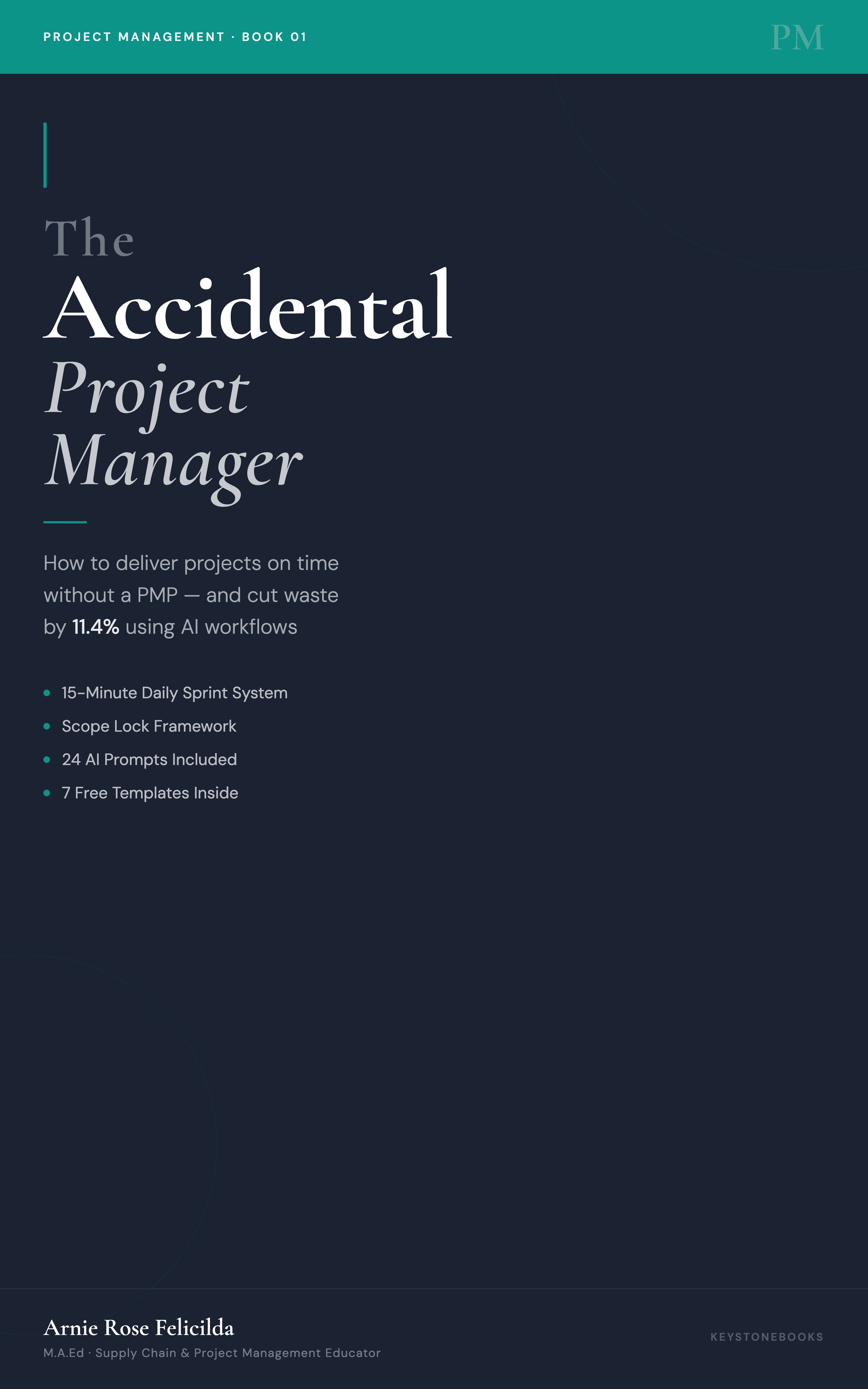
The Accidental Project Manager
How to deliver projects on time without a PMP and cut waste by 11.4% using AI workflows. 15-Minute Daily Sprint System, Scope Lock Framework, and 24 AI Prompts included.
Get the Book →More Supply Chain Reads
- You Don't Know Your True Inventory Cost (And It's Draining Your Cash)
- Why the Cheapest Supplier Is the Most Expensive Decision
Free Supply Chain Tools
Get free supply chain tools. calculators, scorecards, and frameworks.
Built for supply chain managers running inventory, suppliers, and logistics without a manual.